On the 24th of September 2026, Luckan organised a National Dialogue as part of SITRA’s National Dialogues on the theme Working Life Tomorrow. The dialogues were organised across Finland and all explored the question of how Finland will change as a result of work-based immigration.
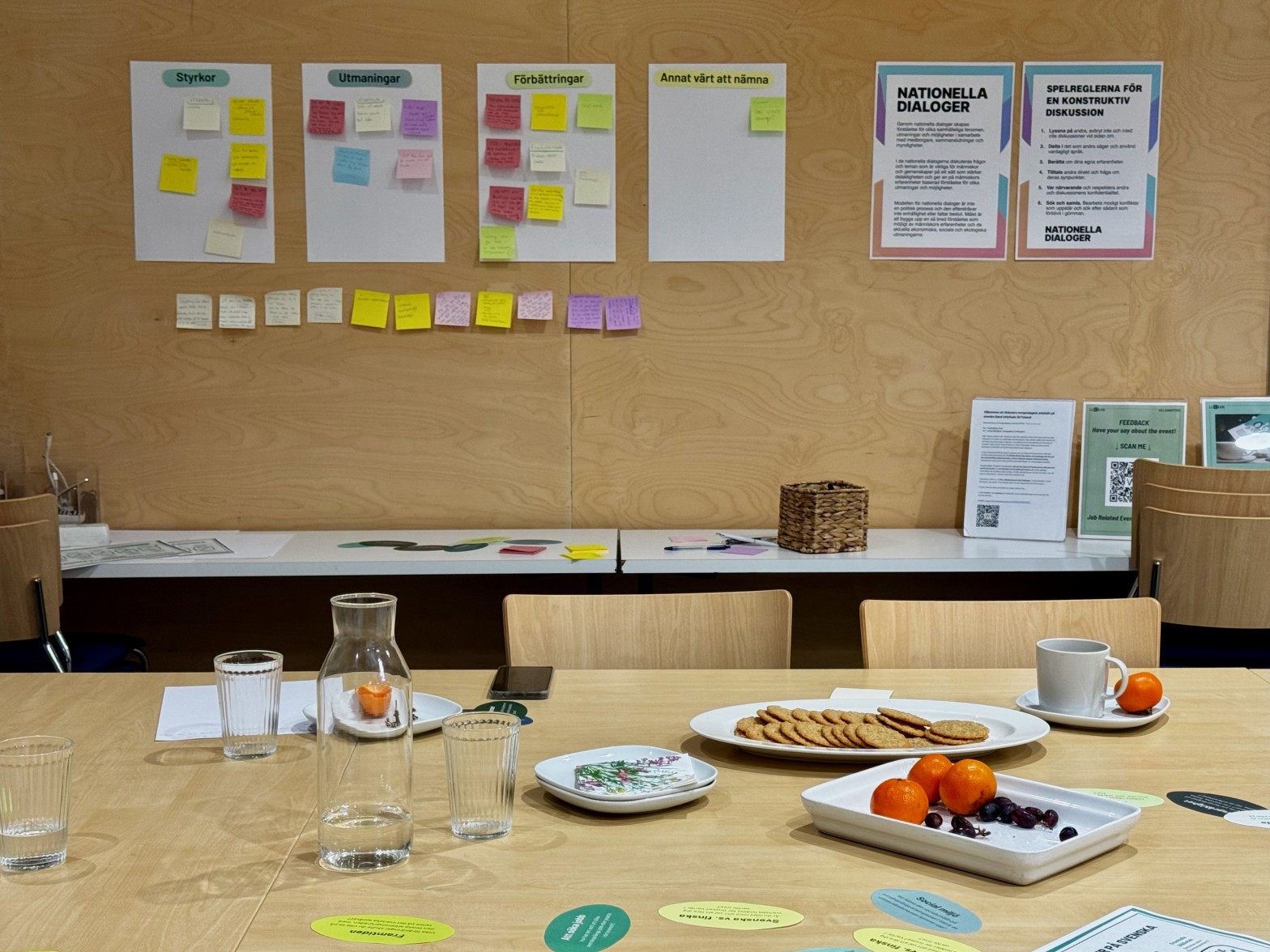
Since Luckan Integration daily supports internationals finding their way in Finland with Swedish, we naturally wanted to focus on Swedish working life. So we sent out invites, put the coffee on to brew, sat down together and asked the question: What does working life in Swedish look like for immigrants – and how can we all make it better in the future?
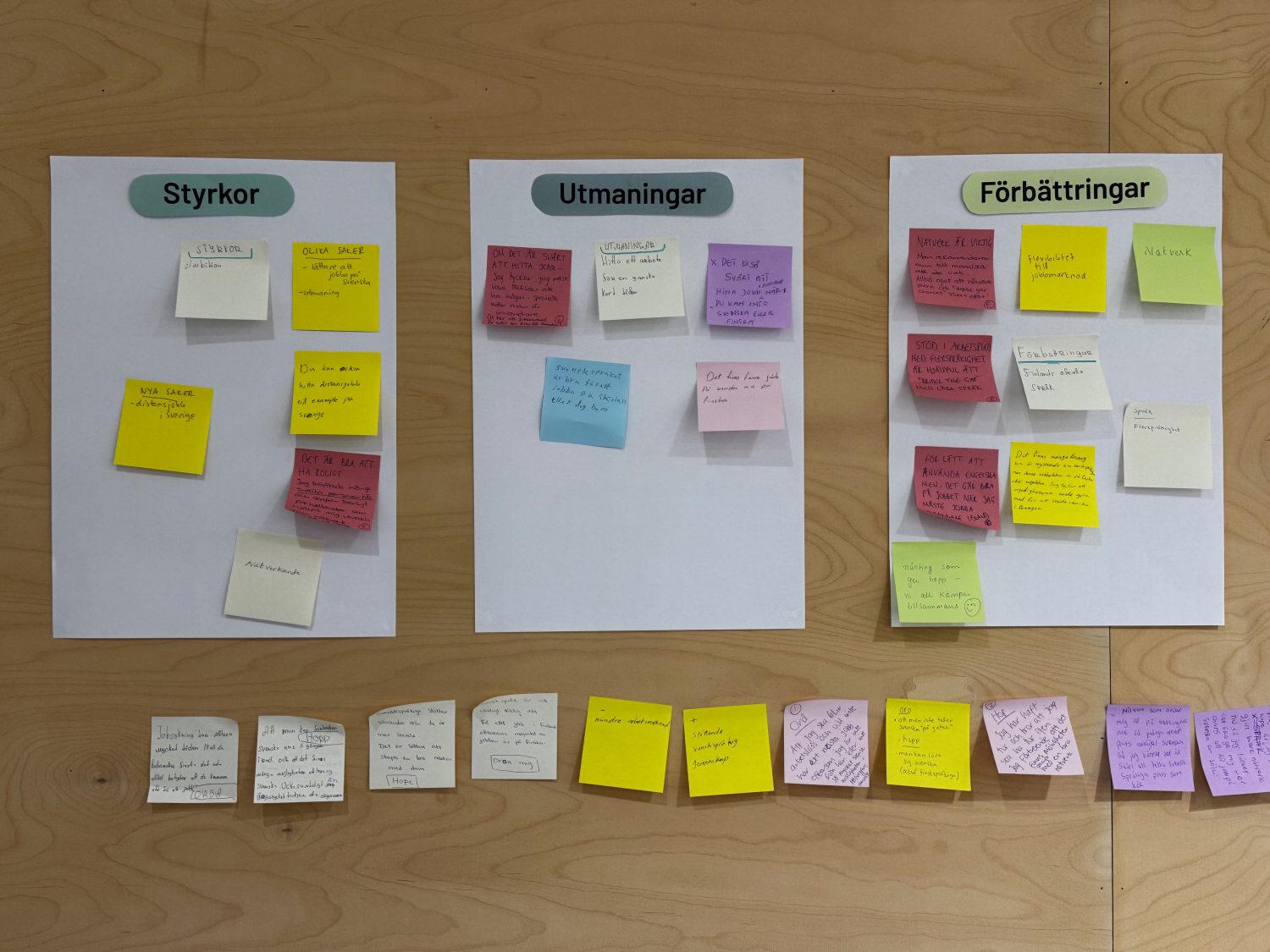
In a small focus group of people who have learned and worked in Swedish in Finland, we shared our experiences. We wanted to find out what the biggest challenges to working in Swedish are, and what strengths there already exist in the language community. Through pair and group discussions using the Timeout method, we got some answers.
Swedish = easier, Finnish = more jobs?
The difficulty of learning any language depends on many factors: which other languages you speak, how effectively you study, and who you can practice with in your own circles and in public life. So while language learning is always relative to your situation, in the focus group we heard a familiar point of view: that many migrants do experience that Swedish is faster to learn than Finnish. It is a Germanic language close enough to English, which can make it more accessible. As such, participants were happy with choosing Swedish in Finland.
Swedish-speakers are however a minority in the capital region, which means there are fewer jobs announced in Swedish than Finnish. As some participants explained their view: right now it is hard for anybody to get a job in Finland. For migrants it can be even harder (due to factors like language barriers and discrimination). For migrants integrating in Swedish (and who wish to work in Swedish, rather than English), a third level of difficulty can be experienced.
Adding to this is the fact that finding spaces where you can practice Swedish is hard, and there is not enough Swedish spoken in public, in customer service or in published information online. One participant had experienced that even the Employment Services cannot always offer support in Swedish, and one has to wait longer for Swedish-speaking staff to be available.
Then again, knowing Swedish opens a door to the broader Scandinavian labour market in Norway and Denmark. With Swedish you can work from home for Scandinavian companies, participants mentioned. You can also find work in Finnish companies who have ties to Swedish counterparts – there your language is an asset. One participant pointed out that although such Finnish-Swedish collaborations are not that many, they have untapped potential.
Networks, networks, networks
Building professional and social networks is a reliable way to increase your chances of finding employment in Finland. Our participants had noted the same. In the discussion we shared experiences of networks leading to jobs: for example, one participant had gotten multiple jobs via the recommendations of personal and professional contacts.
Another person thought that networks in Finland are in fact quite easy to build, given that the population is small. Considering the even smaller number of Swedish speakers, knowing someone could make even more of a difference.
The importance of networks was noted as both a positive and negative. On one hand, they help you get jobs if you know people who can recommend you or give tips. On the other hand, if you don’t have a strong network, finding jobs is harder. As such, we concluded that there is a continued need for services and tools that facilitate migrants in Finland to strengthen their local networks.
At Luckan, we support people in creating professional and social networks through mentoring (see programs FIKA, JobBuddies, CIRKELN), by giving professional guidance, and by facilitating social encounters at various events like our Swedish Language Cafés.
Multilingual workplaces: flexibility or a disservice?
Being able to speak and work in English in Finland can be a positive thing for many, especially in the beginning of one’s Swedish or Finnish studies. Fully English or flexible multilingual workplaces can enable migrants to fully utilise their competencies at work straight away, and it facilitates communication on a more equal playing field.
As such, using English or a combination of English, Swedish, and Finnish can open doors to opportunities both professionally and socially. Some participants saw great value in multilingual environments, and believed that workplaces should be more flexible with the languages spoken. For example, Finnish companies could allow and support English more, or invite Swedish in.
Many in the group had noticed that people are usually quite accommodating in Finland, quickly switching to English in customer service situations. But this accommodation may also mean fewer opportunities for migrants – and Finns learning Swedish, for that matter – to practice the language. Some participants had similarly noted that those who don’t speak English learn Swedish or Finnish faster.
As such, these participants felt that workplaces, and society overall, could challenge migrants pedagogically and stick to speaking Swedish/Finnish. This would lessen the reliance on training wheels while learning. At least, one thing we all could do is to stop assuming what language our conversation partners wish to use, and instead simply ask.
While practising a new language is not always easy when you have a ‘back-up language’, speaking multiple languages is still a strength on the labour market. For two Finnish-speaking participants, Swedish had even been a way to improve career chances and to find meaningful employment outside of their own field, given the enjoyable challenge of learning the language.
Many of the migrants who learn Swedish also speak many other languages, and showed interest in learning Finnish as well. Some participants saw that Swedish and Finnish, overall, are too separate, and that there could be more support for migrants – like in the local school system – to study both.
Worries and hope for the future
Finally, we all shared what worries us and what gives us hope for the future. The two main factors that worry participants are the too few Swedish jobs available in the Capital Region, and the fact that it is hard to practice Swedish in public. With slowly but surely improving networks, some of the participants without jobs were still hopeful for results coming their way.
What gives participants the most hope is the strength and support of the Swedish speaking community that they have found at places like Luckan. As one participant put it: “We are all here together, we fight together, and we can support each other”. Another thought that there still are many opportunities to learn and improve Swedish for anyone interested, for example at Swedish Language Cafés.
In other words, perhaps one just has to know where to look for Swedish in Finland. As always – Luckan is here to help you do just that.
The results of this National Dialogue will be published as a larger report on the Working Life Tomorrow dialogues by SITRA in 2026.