
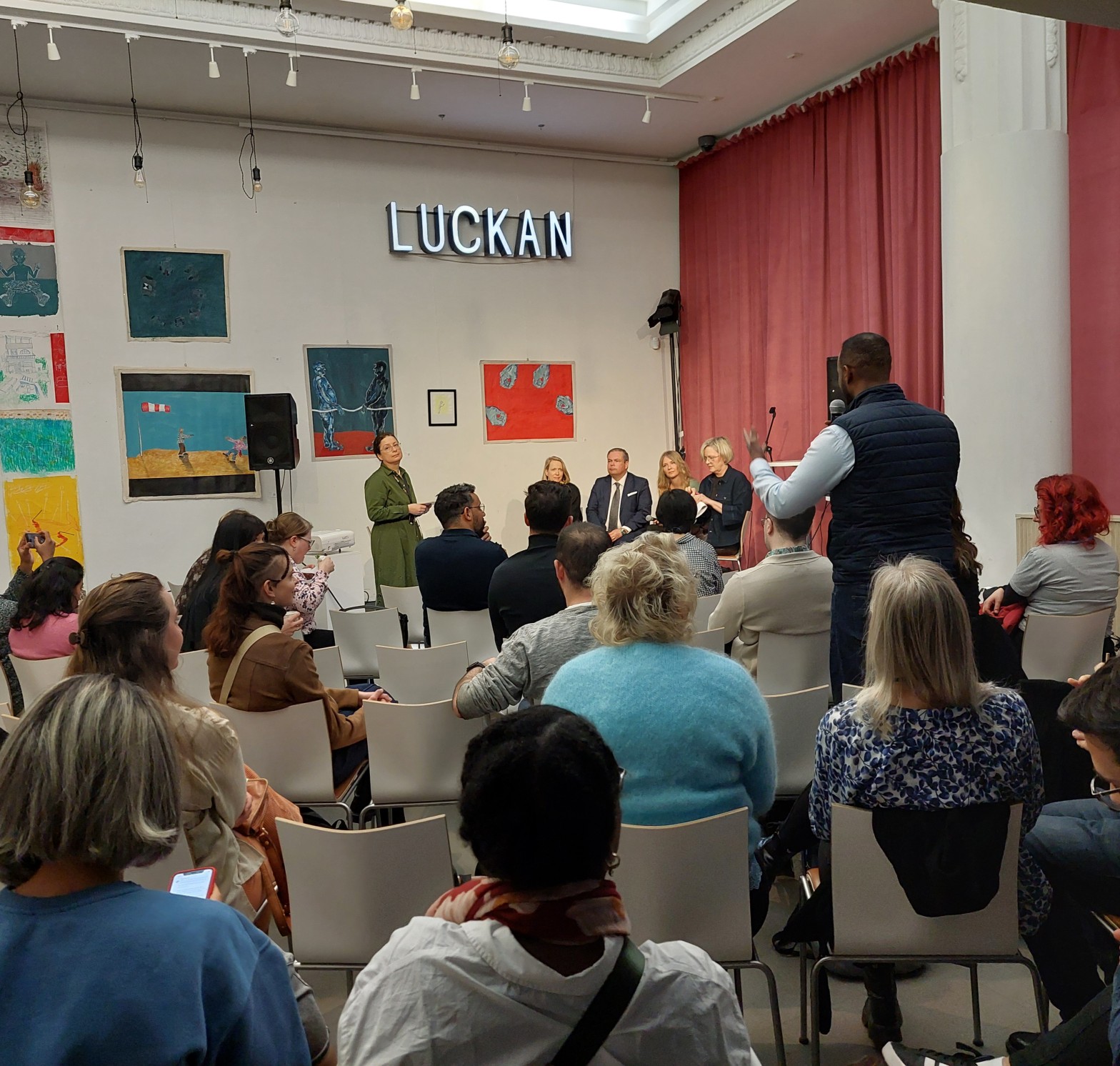
In the morning of the 15th of April, Luckan Helsingfors was the scene of a seminar on a previously somewhat neglected – yet highly relevant, and increasingly visible – topic of exploitation of internationals in the workplace in Finland. The programme of the morning served to shatter the illusion that exploitation is a problem we don’t need to worry about in the safe haven of Finnish welfare society. With five subject matter experts exploring the theme of the day from the vantage point of their own careers, be it legislation, journalism, or academia, the seminar drew a record audience. More than 80 people, including partners, stakeholders and JobBuddies programme participants, joined to listen to our tremendous line-up of speakers, who towards the end came together for a compact panel discussion on the topic.
Veronica Hertzberg and Julia Qesteri from the project team opened the seminar by giving a short recap of the latest developments in the JobBuddies programme itself, followed by a report on Luckan Integration’s experience with exploitation cases in its guidance work from fellow colleague and counsellor Byoma Tamrakar. In recent years, Luckan Integration has been approached with over more and more cases of exploitation both in the workplace and in higher education. Over 200 people have sought help from Luckan in such situations, usually in groups. Work with clients has also included cooperation with other organisations such as Victim Support Finland (RIKU).
First out of the guest speakers was investigative journalist at Helsingin Sanomat and 2025 Finlandia Prize recipient Paavo Teittinen, who reflected on his work exposing exploitation cases in Finland. The passivity of civil society towards the problems surprised him. He gave an example of a recently-introduced fair berry certification, which is aimed at ensuring fair working conditions for seasonal workers picking wild berries. The certification has to date not been adopted by any major grocery chain in the country. Teittinen also remarked that larger scale immigration from countries associated with higher risk of exploitation make those same groups more vulnerable once in Finland. Finally, he noted that exploitation is already common and should be dealt with systematically before the issue grows too big to handle.
The second speaker was Senior Advisor Pia Marttila from Victim Support Finland (RIKU), who talked about key challenges in combating labour exploitation in Finland and how RIKU works to assist victims. Some key challenges that remain are that crimes can be difficult to identify, they might be discarded as mere labour disputes, and that severe cases are prosecuted only as minor ones. An important takeaway from Marttila’s talk was that justice delayed is often justice denied. Since cases are harder to prove after the fact, statutes of limitation can expire, and practical consequences for victims can be difficult to remedy long after the fact. Marttila stressed that one victim getting help encourages others to speak out, whereas segregation, dependency on the employer, and feeling nothing is being done, can lead to a vicious cycle of silence from the exploited. Ending on a positive note, Marttila named recent concrete improvements such as increased awareness of the problem, more institutions involved in prevention, and the introduction of an exploitation-based residence permit.
The morning continued with Venla Roth, Professor of Practice at the University of Turku, discussing the topic especially from the point of view of international students. She identified false expectations before arrival, difficulty getting by financially during the studies in Finland, and challenges finding work after graduation as factors that expose the students to an increased risk of being exploited. Roth pointed out the negative consequences of these problems for Finland’s image abroad, especially among students. She urged decision makers to restore Finland’s reputation internationally, and also ensure Finland is a safe place for everyone to live in.
Next up was Mikko Sipilä, Senior Specialised Prosecutor with focus on Trafficking of Human Beings (THB) cases, who brought the prosecution’s perspective on this crime category in the Finnish legal system. Sipilä lamented the lack of knowledge even among professionals in the legal system about THB cases and explained that a group of more than 60 prosecutors specialising in or interested in TBH cases are cooperating by sharing information among each other about legislation, cases and judgements to help increase awareness and improve legal processes. Sipilä echoed Marttila in saying that a major hurdle in the prosecution of THB cases is scarcity of evidence, and inability or reluctance by victims to speak out about illegal conduct.
Finally, Member of Parliament Eva Biaudet summarised the theme of the morning in her speech, proclaiming that Finland has a false identity of being a country with zero work exploitation. She noted that the discourse among decision makers has shifted in recent years to worrying about smuggling in itself as a phenomenon rather than being concerned about the victims of said trafficking. She affirmed that it is up to our attitudes if people who are being exploited in our country are seen as victims of crime or instead as deserving the treatment they get. Overall, she said, the phenomenon of work exploitation is the same everywhere in the world and will always find its way back into society if allowed favourable conditions.
The talks were followed by a panel discussion among the speakers, with several interesting questions from the audience. The panel touched on, amongst other things, what next steps could be taken to prevent work exploitation. It was agreed that the “out of sight, out of mind” mentality must be done away with and that punishments for perpetrators should be more severe.
The seminar demonstrated the need to move away from harmful stereotypes of Finland as a country above any exploitation, as a safe space where precautions are not needed. Instead, a combination of measures were prescribed to counter the problem: increased and in-depth societal awareness of the problems, lowering the threshold for victims to speak out, and stricter measures against parties benefiting from the status quo. An important initiative towards reaching these goals is the seminar itself, which gathered researchers, lawmakers, journalists, NGOs, and civil servants around the same table for a very fruitful discussion on the challenges. May the cooperation continue to be active for years to come.